

Oral Solid Dose Formulation Consultancy
Find the manufacturing problems before the first batch.
What I assess:
💡 Excipient selection. Each excipient has a job set by the QTPP. I check that the choices deliver the functionality the dose form needs and still process well on the equipment at the manufacturing site.
💡API milling and micronisation. Reducing particle size can change flow, cohesion, static charge, crystalline form, dissolution and content uniformity. I assess those risks before the API is committed to a specification.
💡API bulk and tapped density. Density affects storage, dispensing, hopper flow, blending and capsule fill volume. The effect starts at the API supplier and runs through to the finished product.
💡Segregation potential. Differences in particle size and density between the API and excipients can separate a blend during transfer. Content uniformity failures at scale are expensive to trace, so I assess the risk early.
💡Tablet tensile strength. Tablets need enough strength to survive coating, handling, packing and distribution. I set targets from compaction data, so the plant doesn't discover the limit.

The Problems I Solve
I help you find solutions to:
💡Particle size specifications set without input from drug product development.
💡Content uniformity that passes at small scale and fails at scale.
💡Batch-to-batch variation after an API or excipient supplier change.
💡Tablets that chip, cap or break during coating, packing or transit.
💡A CDMO transfer where nobody has compared the development and manufacturing equipment.
I work with biotechs who outsource manufacture, with teams in the middle of a transfer, and with companies that have started to see problems after one.

The Materials Science Approach...
gives you a powerful lens for product development, scale-up, and manufacturing troubleshooting. It helps you:
💡Design smarter from the outset
💡Build robustness into your process
💡And achieve consistent, reliable product quality at scale
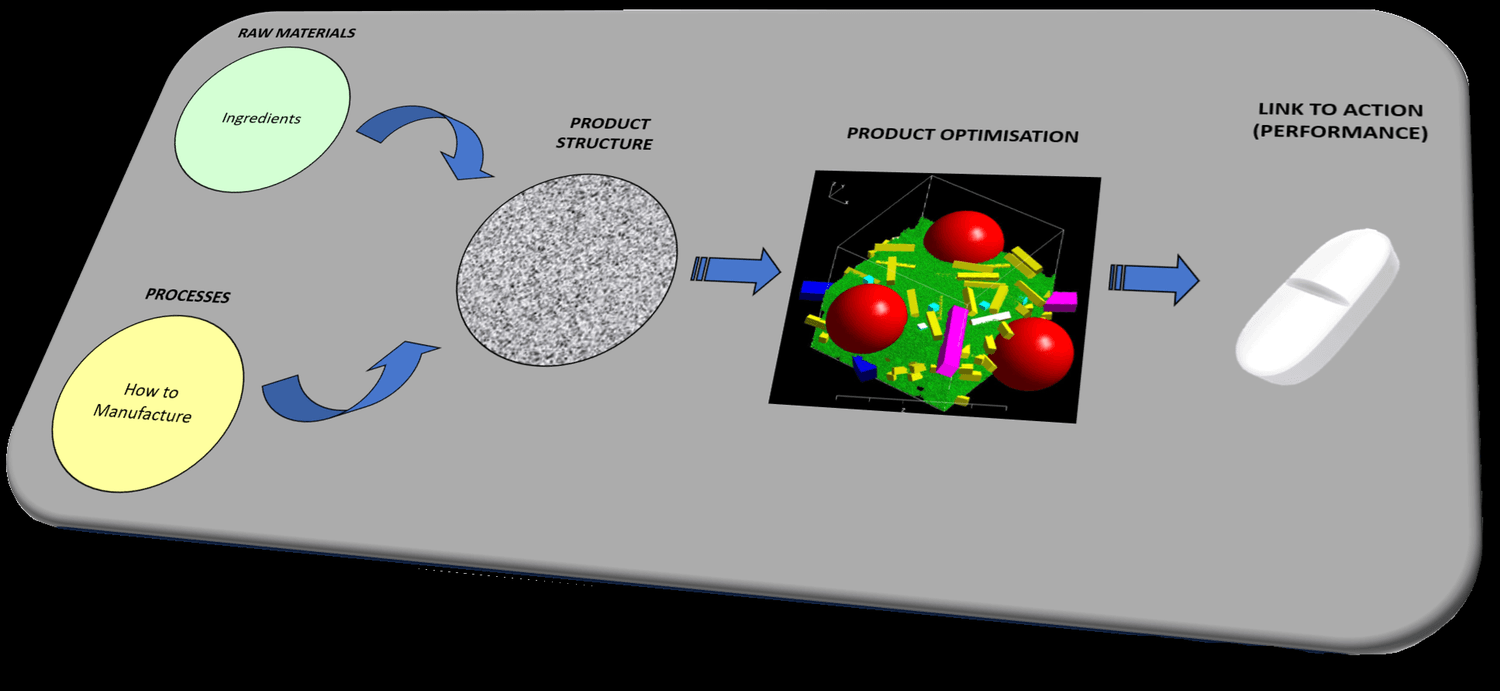
Tablet disintegration at the right stage, which sets the drug release rate and uptake, depends on the tablet microstructure, which in turn results from the combined effects of raw materials and processing.
How We Work
💡Discovery : We start by reviewing your current formulation data, challenges, and goals
💡Analysis & Modelling : Apply materials science tools to understand risks and interactions
💡Validation : Targeted experiments or modelling to test hypotheses
💡Recommendations : Clear, actionable guidance tailored to your team and process
💡Ongoing Support : We stay involved through scale-up, transfer, or troubleshooting as needed
What you Get
💡A manufacturability risk assessment for the formulation.
💡A memo on API particle size and milling or micronisation risk.
💡Tablet tensile strength targets with the data behind them.
💡Input to your control strategy.
💡A list of equipment and process questions for your CDMO.
Virtual Microstructures

A virtual microstructure of the tablet lets me change one variable at a time, such as API particle size or the shape of an excipient, and ask 'What if?' questions about a specific ingredient's shape, size and function in the tablet.
Are you optimising your excipients? Is the API particle size correct?… Knowledge at this level can speed up development of a tablet with optimised dissolution properties.
What Our Customers Say

Don Smith
Inventor & Co-Founder, 1nhaler

From the outset, Paul has proved himself invaluable in the development of our innovative inhaler device. Whilst his materials science knowledge is outstanding, it’s how he applies it that makes all the difference. Through Paul’s rigour and insights, we have confidence that our device is suitable and safe for the end user, as well as conforming and compliant with regulatory standards. He is scientific yet creative, wise yet playful, fearless yet reliably sensible, and unique yet collaborative.

Andrew Walker
Technical Director, HOF Consulting
I'm delighted to recommend Paul. I've worked closely with him on a number of complex inhaler projects, and his skills have been clear from day one. Paul's motto, 'Clarity from Complexity,' isn't just a catchphrase – he lives it!! He has a real talent for cutting through complex problems, finding clear solutions that get everyone on the same page. He's great at explaining tricky subjects in a way we can all grasp and guiding us through tough spots, which really helps us move forward together. Paul brings a strong, science-first mindset to his work. His deep knowledge of materials science has been crucial for our work together, especially his focus on the nitty-gritty details, right down to the particle level, to make sure products are top-notch and reliable. Paul is a fantastic team player. He creates a really positive atmosphere and is always willing to share what he knows, helping everyone work better together. I can't recommend him highly enough. He tackles complexity head-on, drives projects with scientific integrity, and is a brilliant collaborator.

Mike Webb PhD
Independent consultant working on therapeutic oligonucleotide chemistry and analysis
Paul and I worked closely together in GSK Process Robustness for a number of years. He is a first rate scientist with many important achievements in formulation, engineering and analysis that have made a significant contribution to the development and manufacture of important pharmaceutical products. Furthermore, as a leader he has shown excellent people skills developing talent and forging high performing teams. He is smart, adaptable, inspiring and great fun to work with.

Gordon Muirhead
President at GMPharma Limited Pharmaceutical Consultants

Paul has that rare gift of being able to articulate sometimes complex issues and resolution pathways in a clear, simple and often visual way. His deep technical background enables him to apply a sound scientific approach to improving the formulation and process capability of oral solid dose products. Paul has the ability to create clarity from complex systems, such that the best way to tackle the issue at hand… becomes more obvious. He is an excellent presenter and has well developed and proven influencing skills, which were put to good use in his global matrix management role. He was often in situations where there was a “political” aspect in addition to a problem..., and his diplomatic style was certainly an aspect of his ability to deliver the right solution.

Dr Kiren Vyas
Senior Director Pharmaceutical Sciences
I have worked with Paul for over 12 years at GSK. Paul is an accomplished pharmaceutical scientist. Paul is very driven and approachable. Paul is able to find solutions to complex problems in a very structured way. Paul has a great ability to coach and mentor individuals at various levels in the organisation. Paul has a passion for building capability and has used effective new technological methods to deliver training and communication. Paul uses his technical experience effectively and has demonstrated delivery of value to the business across a number of activities including New Product Introduction, Product and Process Development, Scale Up and Commercialisation of Drug Product Manufacturing, Regulatory Submission, Technology Transfer and Product Lifecycle Management.

Lisa McMyn
CEO & Co-Founder, 1nhaler
Paul's customised approach addressed our specific needs in materials analysis and selection for our product.
Other Sectors

Ceramic Composites
Same Ceramic Composite formulation, but with different distributions of iron (white) in the alumina (grey) matrix. This leads to a material with very different toughness properties. The microstructure controls the final performance.

Food Microstructures
The same ice cream formulation can be processed in different ways to enhance the texture. If the process can keep the size of the ice crystals and the air cells very small, the texture appears smoother and creamier when eaten.
Ready to Improve Your Product?
Get in Touch
Send me the problem in two sentences and I'll tell you whether I can help.

Message me here

Omeigo Technical Consulting Ltd
Reg. No. 12996401
167-169 Great Portland Street, 5th Floor
London W1W 5PF
Omeigo Technical Consulting Ltd
Reg. No. 12996401
167-169 Great Portland Street, 5th Floor
London W1W 5PF
Paul.Trusty@Omeigotech.co.uk
Social Media


Created with © systeme.io
Privacy Policy Download | Terms of use | Cookies